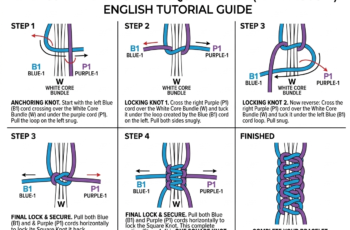
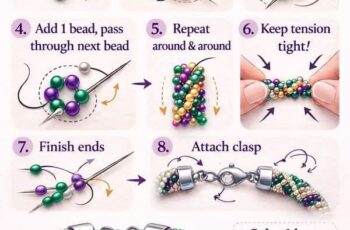
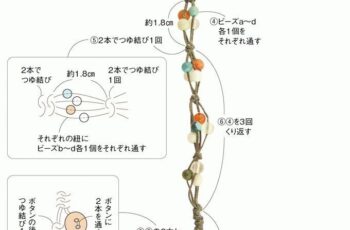
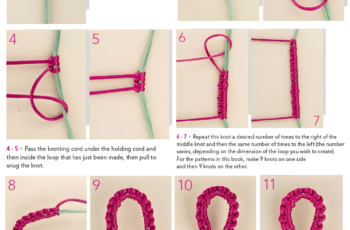
If you’re into macramé, kumihimo, or decorative knotting, mastering the Maru Yotsu (round square knot) and Kaku Yotsu (corner/edge knot) will elevate your projects. These traditional Japanese-inspired knots create beautiful pillar-like or side-chain patterns, perfect for bracelets, bag handles, and cord decorations.
Below, you’ll find a complete materials list and easy-to-follow instructions based on the original diagram notes.

Materials List
| Item | Specification |
|---|---|
| Cord / rope | Required length: 160cm × 2 strands OR 80cm × 4 strands |
| Material type | Cotton, linen, or polyester paracord (2–4mm thickness recommended) |
| Additional tools | T-pins (待針), knotting board or foam pad, scissors, lighter (for synthetic cords) |
💡 Tip: For a 15cm finished length, start with the suggested lengths above. Adjust by multiplying your desired final length × 10–12 for standard knot density.
Part 1: Maru Yotsu (丸四 / 丸結) – Round Square Knot
This knot forms a cylindrical, braided column – ideal for straight bracelets or cord handles.
Step-by-Step Instructions
- Cross placement (十字置)
Place 2 cords in a cross shape. You’ll have 4 working ends: A, B, C, D. - Right turn overlap (右回重)
Take cord B and overlap it over C. Then overlap C over D. - Center pin insertion (中心待針差)
Insert a T-pin at the center to hold the structure.
Overlap A over B. Finally, overlap C over A to form a loop.
Pass the end of A through the center opening. - Even tightening (4本均等引締)
Pull all 4 ends evenly to lock the first knot. - First knot completed (5目完成)
Note: Diagram indicates “5目” as visual reference – repeat steps 2–4 for a total of 5 knots to see the full pillar pattern. - Turn and continue (6目返り結び)
Flip the work and repeat the same sequence to extend the round column.
✅ Result: A round, solid braid with a spiral-like texture.
Part 2: Kaku Yotsu (角四) – Corner / Edge Knot
This knot creates a ladder-like, side-chain pattern (側面連状模様) – perfect for edgings or geometric designs.
Step-by-Step Instructions
First Knot (Right Turn – 右回)
- Overlap B onto A, then C onto B. Insert center pin.
- Overlap A onto B, then D onto C, and finally C onto A. Pass A through the center.
- Pull all 4 ends evenly to tighten.
Second Knot (Left Turn – 左回)
- Now work in reverse: Overlap A onto B, then B onto C.
- Overlap D onto C, then C onto A. Pass A through the center again.
- Tighten evenly.
Repeat Pattern
- Continue alternating: right turn → left turn → right turn…
Each pair of turns completes one full “Kaku” link.
✅ Result: A flat, zigzag-edge chain that looks like connected squares.
Pro Tips for Success
- Always tighten evenly – uneven tension will twist the knot or create gaps.
- Use pins to hold crossing points, especially for the first 2–3 knots.
- Practice on 4 separate 80cm cords before trying with folded 160cm strands.
- For a two-tone effect, use two different colored cords.
Common Uses
| Knot Type | Best For |
|---|---|
| Maru Yotsu | Round bracelets, drawstring bags, plant hanger stems |
| Kaku Yotsu | Keychain edges, belt weaving, decorative borders |